Walk into most distribution centers and ask three different people what “yard management” means, and you’ll get three different answers. One supervisor might describe the process of moving trailers between spots. Another talks about scheduling trucks at the gate. A third mentions their YMS software that supposedly does both.
The confusion is understandable. All three concepts, yard management, dock scheduling, and yard management systems, touch the same physical space and share overlapping goals: get trucks in, get them worked, get them out. But they solve different problems, require different capabilities, and deliver distinct operational benefits.
For facilities struggling with congestion, detention fees, or blind spots in their yard, understanding these differences isn’t academic. It’s the first step toward fixing what’s actually broken.
Why These Terms Get Confused in Modern Logistics
The loading dock and yard sit at the intersection of three worlds: transportation, warehousing, and information systems. Carriers care about arrival windows and turnaround times. Warehouse teams need visibility into what’s coming and what’s staged. IT wants integrations that feed clean data upstream and downstream.
Legacy systems weren’t built for this convergence. Most warehouses evolved their yard operations organically—clipboards at the gate, a whiteboard in the office, maybe an Excel file that one coordinator maintains. When leadership finally says “we need better visibility,” the question becomes: visibility into what, exactly?
Overlapping workflows make the answer murky. A truck arrives, gets checked in, waits for a door, gets unloaded, then repositions to a drop zone or leaves. That single transaction touches scheduling, physical movement, labor allocation, and data capture. No wonder the terminology bleeds together.
Adding to the confusion, many WMS and TMS platforms now claim to “include” yard management or dock scheduling. What they actually offer varies wildly—sometimes it’s just a basic appointment calendar with no enforcement mechanism, other times it’s a bolt-on module that requires extensive customization to function.
The result is that facilities often invest in tools that solve the wrong problem, or try to force one system to do jobs it was never designed for.
What Is Yard Management?
Yard management is the operational practice of controlling trailer movements, staging locations, and asset visibility in the physical yard outside your warehouse. It’s about knowing what’s where, what needs to move next, and how to prevent bottlenecks before trailers start blocking each other.
Key Functions
At its core, yard management involves:
- Directing trailer placement: Assigning arriving trailers to specific parking spots, drop zones, or staging lanes based on load type, priority, or available space.
- Tracking asset locations: Maintaining a current inventory of trailers, containers, and chassis in the yard, including their status—loaded, empty, awaiting repair, ready to ship.
- Orchestrating moves: Coordinating yard jockeys or spotters to reposition equipment as dock doors free up or priorities shift.
- Reducing search time: Ensuring warehouse teams can locate the right trailer in under five minutes instead of circling the yard with a radio.
Good yard management prevents the chaos that happens when high-priority loads get buried behind empties, or when a driver shows up to hook a trailer that’s somehow disappeared.
Who Owns Yard Management in a Typical DC?
Ownership varies by facility size and complexity. In smaller operations, the logistics coordinator or warehouse supervisor handles it alongside dock scheduling. Larger sites often employ dedicated yard masters or spotters who do nothing but move trailers and update positions.
The challenge is coordination. Yard staff need to know which loads the warehouse wants next, but warehouse teams can’t plan if they don’t know what’s staged and ready. When these handoffs rely on radio calls and memory, things slip.
Indicators Your Yard Process Is Breaking Down
You don’t need a consultant to tell you the yard is a mess. The symptoms are obvious:
- Trucks circling for 15 minutes looking for the right spot
- Jockeys moving the same trailer twice because no one logged the first move
- Warehouse staff waiting at the dock because the staged trailer isn’t where it’s supposed to be
- Growing detention fees because repositioning delays eat into load/unload windows
- No clear answer to “how many loaded trailers do we have on-site right now?”
These problems compound. Detention costs pile up. Carriers start avoiding your facility or charging premiums. Labor productivity drops because teams spend more time hunting and coordinating than working.
What Is Dock Scheduling?
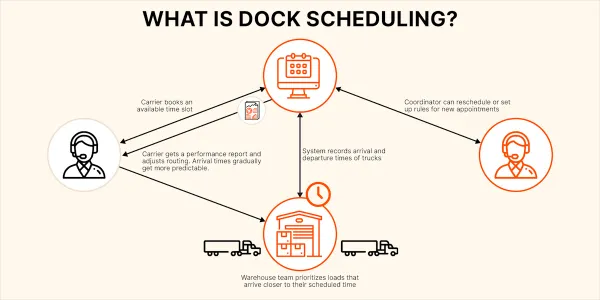
Dock scheduling is the process of assigning specific time slots and dock doors to inbound and outbound trucks. It’s the mechanism that turns chaotic first-come-first-served arrivals into a predictable, manageable flow.
Appointment Booking Between Carriers & Facilities
At its simplest, dock scheduling means carriers book an appointment before they arrive. That appointment specifies a date, a time window (often 30 or 60 minutes), and sometimes a door number. The carrier knows when to show up. The facility knows who’s coming and can prepare accordingly.
This sounds basic, but it’s transformational for facilities that have been running blind. Instead of 12 trucks showing up at 8 a.m. and three at 3 p.m., arrivals spread across the shift. Labor utilization smooths out. Dock doors stay active instead of sitting idle after the morning crush.
Core Workflow: Capacity Limits, Slot Allocation, Notifications, Load Balancing
Modern dock scheduling involves more than just a calendar:
- Capacity limits: Define how many trucks each door can handle per hour, or cap daily arrivals based on labor availability.
- Slot allocation: Automatically assign appointments to available doors based on load type, carrier preference, or facility rules.
- Notifications: Alert carriers and internal teams when appointments are booked, changed, or approaching.
- Load balancing: Distribute arrivals evenly throughout the day to prevent congestion and eliminate idle time.
The result is a facility that operates by design rather than by default.
How Dock Scheduling Reduces Long Lines, Miscommunication, and Unplanned Arrivals
When trucks arrive without appointments, every arrival is a disruption. Coordinators scramble to find a door. Warehouse teams drop what they’re doing to handle the unexpected load. Drivers sit in line, often for hours, because no one planned for their arrival.
Dock scheduling eliminates the surprise. Arrivals become predictable. Teams can stage equipment, allocate labor, and sequence work based on what’s actually coming. Carriers appreciate the transparency—they know their slot, they get notifications if anything changes, and they’re not competing with a line of trucks for the same door.
The operational data from how dock scheduling works also creates accountability. When a carrier books a 2 p.m. slot and arrives at 5 p.m., the record is clear. Facilities can use that data to negotiate better terms or shift priorities to carriers who respect the schedule.
What Is a Yard Management System (YMS)?
A Yard Management System is software that provides real-time visibility and control over trailer movements, locations, and statuses in the yard. It’s the operational layer that sits between dock scheduling and physical yard management, turning what was a manual, memory-dependent process into a data-driven workflow.
System-Level Functionality
A modern YMS typically includes:
- Real-time yard map: A visual dashboard showing every trailer’s location, status (loaded, empty, in-process), and dwell time.
- Check-in automation: Digital gate check-in via RFID, license plate recognition, or tablet-based logging that captures arrival timestamps and load details.
- Task management: Automated work orders for yard jockeys specifying which trailers to move, where to stage them, and why.
- Status tracking: Live updates when trailers are hooked, moved, spotted at doors, or checked out.
The core value of a YMS is eliminating the question “where is trailer XYZ?” Every stakeholder—warehouse supervisor, logistics coordinator, carrier—sees the same current state.
Integrations with WMS, TMS, ERP
YMS platforms don’t operate in isolation. They pull data from and push updates to other systems:
- WMS integration: When a load is received and processed, the YMS marks the trailer as empty and available for repositioning or pickup.
- TMS integration: Outbound load details flow from the TMS into the YMS, triggering yard staff to stage the correct trailer at the correct door.
- ERP integration: Yard dwell times, detention costs, and throughput metrics feed into financial and operational reporting.
What a modern YMS includes is this ability to act as a central nervous system for everything happening outside the warehouse walls.
Why YMS Evolved Beyond Spreadsheets & Clipboards
Spreadsheets break down as soon as two people need to update them simultaneously. Clipboards can’t send alerts when a trailer has been sitting for three hours. Radio calls don’t create an audit trail.
YMS software emerged because the volume and complexity of modern yard operations outpaced manual tracking. A facility turning 40 trailers a day might survive on a whiteboard. A facility turning 150 needs real-time visibility, automated tasking, and integration with upstream systems.
The shift toward drop trailer programs, cross-docking, and just-in-time delivery amplified this need. When trailers spend days or weeks on-site instead of hours, tracking becomes mission-critical. You can’t run a drop yard effectively without knowing what’s loaded, what’s empty, what’s been inspected, and what’s ready to ship.
Comparison: Yard Management vs Dock Scheduling vs YMS
| Dimension | Yard Management | Dock Scheduling | Yard Management System (YMS) |
|---|---|---|---|
| What it solves | Physical movement and staging of trailers | Appointment predictability and door allocation | Real-time visibility and task automation |
| Who uses it | Yard jockeys, spotters, warehouse supervisors | Logistics coordinators, carriers, gate staff | Operations managers, IT, logistics teams |
| Time horizon | Real-time to hourly (immediate moves) | Daily to weekly (advance scheduling) | Real-time with historical reporting |
| Required data | Current trailer locations, status, priorities | Carrier info, load details, time slots, door availability | All of the above plus integrations to WMS/TMS/ERP |
| Operational KPIs influenced | Yard throughput, search time, move efficiency | Dwell time, on-time arrivals, door utilization | Detention fees, yard density, end-to-end visibility |
The distinctions aren’t just semantic. Each addresses a different operational bottleneck. Dock scheduling fixes the front end—arrivals. Yard management fixes the middle—staging and movement. YMS fixes the system—visibility and coordination across all stakeholders.
When You Need Dock Scheduling Only vs When You Need YMS
Not every facility needs the full stack. The decision depends on volume, complexity, and the specific pain points you’re trying to solve.
Volume and Complexity Thresholds
Dock scheduling alone makes sense when:
- You handle more than 15 trucks per day
- Most loads are live (arrive, unload, leave same day)
- Arrivals are unpredictable and causing congestion
- Your main problem is too many trucks showing up at once
Start with dock scheduling to improve yard visibility instantly by controlling when trucks arrive. That single change often resolves 60–70% of operational friction. You likely need YMS when:
- You run a drop trailer program with 50+ trailers staged on-site
- Trailers regularly sit for days or weeks awaiting cross-dock, consolidation, or repair
- You have multiple buildings or yard zones that require coordinated movement
Live Unload vs Drop Trailer Operations
Live unload operations—where drivers wait while their trailer is worked—benefit most from tight dock scheduling. The goal is speed. Get the truck to the door fast, unload it, and release the driver. Yard management is minimal because nothing sits.
Drop trailer operations are the opposite. Drivers hook, drop, and leave. Those trailers might sit for hours or days before being worked. Without a YMS, you lose track of what’s staged where, what’s ready to load, and what’s waiting on inspection or repair. The yard becomes a black hole.
Carriers Demanding Visibility
If your carrier base includes large 3PLs or national fleets that expect real-time status updates, a YMS becomes necessary. These carriers want to know when their trailer arrived, when it was spotted at a door, when it was loaded, and when it’s ready for pickup—all without making a phone call.
Multi-Building, Multi-Yard Networks
Facilities with campus-style layouts—multiple buildings, separate inbound/outbound yards, staging areas, or maintenance zones—need YMS-level orchestration. Dock scheduling books the appointment, but YMS ensures the trailer gets shuttled to the right building, staged at the right zone, and moved to the right door when capacity opens up.
Without system-level coordination, you’re back to radio calls and guesswork.
How These Systems Work Together in a Modern Operation
The highest-performing facilities don’t treat these as competing solutions. They use them in sequence.
Dock scheduling feeds yard planning. When a carrier books a 10 a.m. slot for an inbound pallet load, that information flows into the yard plan. Staff know to expect that trailer, can reserve a staging spot if needed, and can pre-allocate labor for unloading.
YMS handles movement, tasking, and visibility. Once the truck arrives and checks in, the YMS logs its location. If it’s a drop load, the system queues a task for a yard jockey to move it to a staging lane. If it’s a live load and the door is ready, the system directs the driver straight to the dock. If the door isn’t ready, the system tracks dwell time and sends alerts when thresholds are hit.
Combined impact on detention fees & throughput. Facilities running both dock scheduling and YMS report 40–60% reductions in detention costs because trucks aren’t sitting idle and warehouse teams aren’t scrambling to locate trailers. Throughput increases because every step—arrival, staging, loading, departure—operates on data rather than radio calls and memory.
The integration between the two creates a feedback loop. Dock scheduling reduces arrival variability. Lower variability makes yard planning easier. Better yard planning shortens dwell times. Shorter dwell times make the schedule more reliable. Carriers start trusting the process, which reduces no-shows and late arrivals, which further stabilizes the operation.
It’s a virtuous cycle, but it only works if both pieces are in place.
Common Pain Points These Tools Solve
Let’s ground this in the problems facilities actually face day-to-day.
Congestion. When 15 trucks show up at 7 a.m., the gate becomes a parking lot. Drivers argue over who was first. Coordinators scramble to assign doors. The first truck might not get worked until 9 a.m. Dock scheduling spreads arrivals across the shift, eliminating the morning rush and the afternoon lull.
Communication gaps. A carrier calls to confirm their appointment. The coordinator checks the board and says door 3 at 2 p.m. The warehouse supervisor thinks door 3 is reserved for a high-priority outbound load. The truck arrives, and no one knows which door to use. Moving toward automated yard operations means these handoffs happen in software, not phone calls.
Late carriers. A truck books a 10 a.m. slot but doesn’t arrive until 2 p.m. By then, the warehouse has moved on to other priorities. The late arrival disrupts the afternoon plan and pushes other loads back. With dock scheduling, late arrivals are tracked, and carriers who repeatedly miss windows can be held accountable or deprioritized.
Detention & demurrage. Trucks sitting for hours cost money—$50 to $100 per hour in detention fees, often more for reefer units. Most facilities don’t realize how much they’re paying until they start tracking dwell times. YMS makes dwell visible in real-time and highlights which processes are causing delays.
Over/under utilization of doors. Some doors stay slammed all day. Others sit empty for hours. Dock scheduling with capacity rules ensures appointments are distributed evenly across available doors, so no single door becomes a bottleneck while others go unused.
Labor inefficiency. When warehouse teams don’t know what’s coming or what’s staged, they can’t plan their work. Forklifts sit idle waiting for the next load. Workers stand around because the trailer they need isn’t spotted yet. Better visibility means better labor allocation, which directly impacts labor cost per unit handled.
Where DataDocks Fits In
DataDocks operates at the intersection of dock scheduling and yard visibility. It’s not just an appointment calendar, and it’s not a heavyweight YMS designed for container terminals. It’s purpose-built for the operational reality most distribution centers face: you need tight control over arrivals, real-time visibility into what’s staged, and clean data flowing between your teams, your carriers, and your upstream systems.
The platform combines:
- Carrier self-service portal: Carriers book, reschedule, or cancel appointments online. No phone calls. No email chains. Confirmations and reminders go out automatically.
- Live dock dashboard: See every appointment, door assignment, and load status in real-time. Drag-and-drop to adjust on the fly. Color-coded timers show when trucks are approaching, on-time, or overdue.
- Yard visibility: Track trailer locations, statuses, and dwell times. Know what’s staged, what’s being worked, and what’s ready to go without walking the yard.
- Capacity rules engine: Set limits by day, shift, door, or load type. The system enforces your rules so appointments never exceed capacity.
- Integrations: Push and pull data from your WMS, TMS, or ERP via API. No double entry. No data silos.
It’s not trying to replace your WMS or become your TMS. It’s the connective tissue that makes shipping and receiving predictable, visible, and measurable.
Final Recommendation Framework
If you’re trying to decide where to start, here’s a simple guide:
If your main issue is predictability at the door → Start with dock scheduling. Your arrivals are chaotic, trucks are lining up, and you’re constantly reacting to surprises. Implementing appointment-based scheduling will cut wait times, reduce congestion, and give you data to hold carriers accountable. Most facilities see results within the first month.
If your main issue is visibility in the yard → You need yard management or a YMS. Trailers are getting lost, priorities are unclear, and you’re spending too much time hunting for equipment. A system that tracks locations and automates tasking will eliminate the blind spots and reduce wasted labor.
If you struggle with both → Look for a combined platform. Dock scheduling and yard visibility aren’t separate problems—they’re two sides of the same operational challenge. A solution that handles appointment booking, door assignment, yard tracking, and stakeholder communication will give you the control and transparency you need without forcing you to stitch together multiple tools.
Most importantly, don’t try to force your WMS or TMS to do jobs they weren’t designed for. Use the right tool for the right problem, integrate them cleanly, and focus on the operational outcomes that matter: lower dwell times, fewer detention fees, higher throughput, and a yard that finally runs the way it’s supposed to.