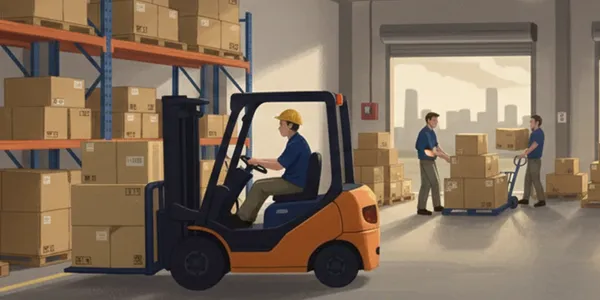
Most logistics teams treat inbound and outbound as separate operations. Procurement owns inbound—getting materials from suppliers into the facility. Fulfillment owns outbound—shipping finished goods to customers. Different people, different priorities, different KPIs.
But walk into the warehouse and both flows converge at the same place: the loading dock. The same doors, the same yard, the same coordinators juggling arrivals and departures. When the dock becomes a bottleneck, it doesn’t matter how well-optimized your procurement or fulfillment processes are. Everything slows down.
Understanding the difference between inbound and outbound logistics is useful. But fixing the dock—the physical chokepoint where both flows meet—is where ROI shows up first. Smooth out the dock and you improve inventory accuracy, reduce detention fees, increase throughput, and make life easier for both sides of the operation.
Inbound vs Outbound Logistics: Definitions and Why They Matter
Before you can fix the dock, you need to understand what’s flowing through it.
What Is Inbound Logistics?
Inbound logistics is the process of moving materials, components, and supplies into your facility. It starts when you place a purchase order and ends when those goods are received, inspected, and put away in storage.
Key inbound activities include:
- Procurement and vendor management: Negotiating terms, placing orders, and coordinating delivery schedules with suppliers.
- Transportation inbound: Arranging carriers (or receiving from supplier-arranged freight) and managing inbound lanes.
- Receiving and inspection: Checking shipments against POs, validating quantities and condition, and documenting discrepancies.
- Putaway: Moving received goods from the dock into storage locations within the warehouse.
- Returns processing: Handling defective or incorrect materials being sent back to suppliers.
Inbound logistics is fundamentally about securing supply. If it breaks down, production stops or orders can’t be fulfilled. The primary stakeholders are procurement, receiving teams, and suppliers.
What Is Outbound Logistics?
Outbound logistics is the process of moving finished goods out of your facility to customers, retailers, or distribution partners. It begins when an order is placed and ends when the product reaches its destination.
Key outbound activities include:
- Order management: Processing customer orders, allocating inventory, and generating pick lists.
- Picking and packing: Pulling items from storage, packing them for shipment, and staging them at the dock.
- Loading and shipping: Coordinating with carriers, loading trucks, and dispatching shipments.
- Delivery and tracking: Monitoring shipments in transit and ensuring on-time delivery.
- Returns and reverse logistics: Handling customer returns, inspecting items, and restocking or disposing of returned goods.
Outbound logistics is about fulfilling demand. If it fails, customers don’t get their orders, delivery windows are missed, and the business loses revenue and reputation. The primary stakeholders are fulfillment teams, transportation, and customers.
Key Differences at a Glance
| Dimension | Inbound Logistics | Outbound Logistics |
|---|---|---|
| Direction | Materials coming into the facility | Finished goods leaving the facility |
| Primary Partners | Suppliers, manufacturers, freight forwarders | Customers, retailers, 3PLs, last-mile carriers |
| Typical Processes | Procurement, receiving, putaway, supplier returns | Order picking, packing, loading, delivery, customer returns |
| Core KPIs | Receiving accuracy, putaway time, supplier on-time delivery | Order fill rate, OTIF (on-time in-full), delivery speed |
| Main Risks | Supply delays, quality issues, stockouts | Late shipments, incorrect orders, damaged goods |
| Dock Interactions | Unloading inbound freight, validating BOLs, staging for putaway | Loading outbound freight, confirming orders, releasing carriers |
The differences matter because the failure modes are different. An inbound delay might mean production downtime. An outbound delay might mean a missed retailer appointment and chargebacks. But both failures often trace back to the same root cause: congestion and poor coordination at the dock.
Where Inbound and Outbound Meet: The Loading Dock
The loading dock is the handoff point between your facility and the outside world. It’s where inbound freight transitions from carrier control to warehouse control. It’s where outbound freight moves from warehouse control to carrier control. And it’s where both flows compete for the same scarce resource: dock doors.
In theory, the dock should be a frictionless interface. Trucks arrive on schedule, get worked quickly, and leave. Warehouse teams have clear visibility into what’s coming and what’s going. Carriers know when to show up and how long they’ll wait.
In practice, the dock is often chaos. Trucks arrive unannounced. Coordinators scramble to find available doors. Warehouse teams don’t know what’s staged where. Carriers sit for hours, racking up detention fees. Safety incidents pile up because everyone’s rushing to clear the backlog.
Many “inventory problems” or “customer service problems” are actually dock problems in disguise. Receiving can’t process inbound freight fast enough, so raw materials don’t make it to production on time. Outbound loads aren’t staged properly, so the truck sits at the dock waiting for freight that isn’t ready. Documentation errors at receiving cascade into picking errors downstream.
The dock isn’t just a physical space. It’s the operational bottleneck that determines how fast your facility can move goods in both directions. Fix the dock and you fix a lot of upstream and downstream problems at the same time.
Common Bottlenecks at the Dock for Inbound and Outbound Flows
Bottlenecks manifest differently depending on whether you’re talking about inbound or outbound, but they all slow down dock throughput and drive up costs.
Inbound-Specific Bottlenecks
Late arrivals: Suppliers or carriers miss their scheduled delivery windows, arriving hours or even days late. This disrupts receiving schedules, forces warehouse teams to juggle priorities, and creates peaks and valleys in labor utilization.
Poor appointment discipline: Some facilities don’t require appointments for inbound freight. Others nominally use appointments but don’t enforce them. The result is the same: trucks show up whenever they want, often all at once in the early morning.
Incomplete paperwork: BOLs are missing, PO numbers don’t match, customs documents are incomplete. Receiving staff can’t process the load until someone tracks down the missing information, which delays unloading and extends dwell time.
Unknown trailer contents: The PO says 20 pallets of widgets, but the truck has 22 pallets and three of them are a completely different SKU. Receiving teams waste time sorting out discrepancies instead of unloading.
Limited receiving lanes: Many facilities have more outbound doors than inbound. When inbound volume spikes, there aren’t enough doors to handle it, so trucks wait in the yard.
Outbound-Specific Bottlenecks
Last-minute order changes: A customer changes an order 30 minutes before the truck is scheduled to load. Picking teams scramble to pull different items, staging gets disrupted, and the load isn’t ready when the carrier arrives.
Misaligned picking and wave planning: The warehouse picks and stages orders based on internal priorities that don’t match the outbound dock schedule. Loads sit staged for hours because no carrier is booked yet, or carriers arrive but freight isn’t ready.
Insufficient staging space: There’s nowhere to stage outbound loads, so they sit on the dock floor blocking doors or get stacked in the yard where they’re hard to find when the truck finally shows up.
Dock doors blocked by early or late carriers: An inbound truck arrives late and occupies a door that was supposed to be free for outbound loading. Or an outbound carrier shows up two hours early and parks at a door that’s still being used for receiving.
Shared Issues That Slow Both Sides
Dwell time: Whether it’s inbound or outbound, trucks sitting idle at the facility cost money. The longer a truck waits, the higher the detention fees and the more frustrated the carrier.
Manual check-in: Drivers pull up to the gate, hand over paperwork, and wait while someone manually enters data or looks up their appointment on a clipboard. This process takes 10–15 minutes per truck and creates a queue at the gate.
Poor visibility to yard and dock status: Coordinators don’t know which doors are open, which trailers are staged where, or which loads are ready to work. They spend half their day on the phone or radio trying to figure out what’s happening.
Safety slowdowns: Congested docks are dangerous docks. When trucks are backed up and forklifts are weaving through tight spaces, operations slow down to reduce the risk of accidents. That’s the right call for safety, but it compounds the throughput problem.
Research on loading dock efficiency consistently identifies poor scheduling, limited visibility, and manual processes as the primary drivers of congestion—not just “not enough doors.”
The True Cost of Dock Bottlenecks
Dock bottlenecks aren’t just inconvenient. They’re expensive, and the costs show up in multiple places.
Direct Costs: Detention Fees
Most carriers offer a free waiting window—typically two to four hours from arrival to departure. After that, detention fees kick in. Rates vary, but $50 to $100 per hour is common. Reefer units and specialized equipment can cost even more.
A facility turning 50 inbound and 50 outbound loads per week, with an average of 30 minutes of excess dwell per load, pays roughly:
- 100 loads/week × 0.5 hours × $75/hour = $3,750/week
- Over a year: $195,000 in detention fees alone.
That’s money flowing straight out of the logistics budget into carrier pockets because the dock couldn’t process trucks on time. For more details on how carriers calculate these charges, see the real cost of detention and accessorial fees.
Indirect Costs: Missed Windows and Lost Goodwill
Beyond detention, dock bottlenecks create cascading failures:
Missed delivery windows: An outbound load sits at the dock for three hours instead of one. The truck leaves late, misses the retailer’s receiving window, and the shipment gets rejected. The facility eats the cost of re-delivery plus potential chargebacks.
Lower tender acceptance: Carriers track which facilities respect their drivers’ time. Sites with chronic delays get flagged as “bad shippers.” When capacity tightens, carriers decline loads or demand higher rates to service those lanes.
Overtime labor: When inbound trucks arrive in a morning rush, receiving teams can’t keep up. The backlog extends into the afternoon, forcing supervisors to authorize overtime to clear it. That same pattern repeats on the outbound side when loads aren’t staged on time.
Idle equipment: Forklifts and dock levelers sit unused during slow periods, then get overworked during peaks. That uneven utilization shortens equipment life and increases maintenance costs.
Eroded OTIF: On-time in-full performance suffers when outbound shipments are delayed by dock congestion. Customers notice. Retailers impose fines. The brand takes a hit.
Simple Worked Example
Let’s say your facility ships 200 loads per week and each load experiences one extra hour of dwell due to dock bottlenecks. At $75/hour in detention, that’s $15,000 per week or $780,000 per year.
Now add the indirect costs: two missed retailer windows per week at $500 each in chargebacks, 10 hours of overtime per week at $30/hour to clear backlogs, and one re-tender per week at $300 due to late departures. That’s another:
- Chargebacks: $1,000/week = $52,000/year
- Overtime: $300/week = $15,600/year
- Re-tenders: $300/week = $15,600/year Total annual cost of dock bottlenecks: $863,200. Most facilities underestimate these numbers because the costs are scattered across different budget lines. Detention shows up in transportation. Overtime is in labor. Chargebacks hit customer service. But they all trace back to the same root cause: poor dock coordination.
How to Diagnose Bottlenecks Across Inbound and Outbound Logistics
You can’t fix what you can’t measure. Diagnosing dock bottlenecks starts with visibility into the actual flows and metrics that matter.
Map the Flows To and From the Dock
Draw a simple process map showing how inbound and outbound flows converge:
Inbound flow: Truck gate → yard staging → dock door → unloading → receiving inspection → putaway to storage.
Outbound flow: Storage → picking → packing → staging area → dock door → loading → truck departure.
The dock sits at the intersection. It’s the shared resource both flows depend on. When the dock is congested, both flows slow down. When the dock runs smoothly, both flows accelerate.
Mapping the process makes it easier to spot where handoffs break down. Maybe inbound trailers sit in the yard too long because no one notified the spotter that a door opened up. Maybe outbound loads aren’t staged near their assigned doors, so loading takes twice as long as it should.
Metrics That Show the Dock Is Your Bottleneck
A few key metrics reveal whether the dock is holding back overall performance:
Door turns per day: How many loads does each door handle in a 24-hour period? Low door turns suggest underutilization or slow processing. Uneven door turns (some doors slammed, others idle) suggest poor scheduling.
Truck turnaround time: From gate arrival to gate departure, how long does the average truck spend at your facility? Anything over 90 minutes for a live load or 30 minutes for a drop-and-hook suggests delays.
Dwell time by lane or load type: Break down dwell time by inbound supplier, outbound customer, carrier, or commodity type. If one lane consistently takes twice as long as others, that’s where to focus improvement efforts. For a deeper look at this metric, see how to measure and reduce dwell time.
Percentage of loads incurring detention: If more than 10% of loads trigger detention fees, the dock is a bottleneck.
Percentage of appointments missed or walk-ins: If 30% of trucks arrive unscheduled or miss their window by more than 30 minutes, scheduling discipline is weak and congestion is inevitable.
Percentage of OTIF failures tied to dock delay: Track how many late shipments are caused by dock issues versus warehouse issues. If the dock is the primary driver, that’s your signal to act.
Frontline Signals from Drivers and Coordinators
Data tells part of the story, but the people working the dock every day see the rest:
- Repeating complaints from carriers: “Your facility is always backed up.” “We can never get in on time.” “Our drivers hate coming here.”
- Peak-hour gridlock: Every morning at 8 a.m., the yard is full and trucks are blocking each other. Every afternoon at 4 p.m., the opposite—empty doors and idle crews.
- Mystery delays not tied to inventory or picking: Loads are picked and staged on time, but they sit at the dock for an hour waiting for an available door or a truck that hasn’t arrived yet.
When coordinators spend more time managing the chaos than executing the plan, you have a dock bottleneck problem.
Fixing Inbound Bottlenecks at the Dock First
Inbound improvements start with controlling when trucks arrive and what information flows ahead of them.
Use time slot management to smooth arrivals by supplier, mode, and lane. Instead of letting all inbound suppliers arrive between 7 and 9 a.m., spread them across the shift. Reserve specific time slots for high-volume suppliers, and use time slot management best practices to enforce capacity limits so no single window gets overbooked.
Reserve door capacity for known high-volume or high-priority suppliers. If Supplier A ships 10 pallets twice a week and Supplier B ships full truckloads daily, Supplier B should get priority door access. Build that priority into the scheduling rules so coordinators don’t have to make judgment calls on the fly.
Ensure documentation and data validation at the booking stage. Require suppliers or carriers to submit PO numbers, pallet counts, and temperature requirements when they book appointments. If the data is incomplete or doesn’t match, flag it before the truck leaves the supplier’s facility. This prevents surprises at receiving and cuts down on delays caused by missing paperwork.
Link inbound appointments to WMS or ERP. When an inbound appointment is booked, push that data into the warehouse management system so receiving teams can allocate labor and stage equipment. The crew should know exactly what’s coming at 10 a.m., not find out when the truck shows up.
These changes don’t require new doors or more staff. They require coordination and a system that enforces the rules automatically instead of relying on manual follow-up.
Fixing Outbound Bottlenecks at the Dock First
Outbound improvements require aligning internal warehouse processes with external carrier schedules.
Align picking and wave planning with the outbound dock schedule. If a truck is booked to load at 2 p.m., picking should be complete by 1:30 p.m. and the load should be staged near the assigned door. This sounds obvious, but many warehouses plan picking waves based on order priority or warehouse zones, not dock appointment times. The result is loads ready hours early (wasting staging space) or loads not ready when the truck arrives (causing detention).
Staging rules: where outbound loads wait, how long, and how they are prioritized. Define clear staging zones—where completed orders sit before loading, how they’re organized (by carrier, by appointment time, by customer), and how long they’re allowed to sit before someone escalates. Poor staging discipline is one of the most common causes of outbound delays.
Carrier self-service portals to reduce manual calls and emails. Let outbound carriers book pickup appointments online, receive automated confirmations and reminders, and update ETAs if they’re running early or late. This eliminates the back-and-forth phone tag that wastes coordinators’ time and gives carriers better visibility into when they can expect to load. For more on how scheduling platforms work, see our complete guide to dock scheduling.
Improved ETA visibility. When outbound carriers provide live ETAs, warehouse teams can adjust picking priorities or shift staging to match actual arrival times instead of guessing. This small change reduces idle time and keeps doors active.
How Modern Dock Scheduling Platforms Support Inbound and Outbound Logistics
Dock scheduling software doesn’t replace your WMS or TMS. It sits between them, coordinating arrivals, managing door assignments, and providing real-time visibility across both inbound and outbound flows.
Core Capabilities to Look For
A modern dock scheduling platform should include:
Centralized dock calendar with capacity limits: One shared view showing every inbound and outbound appointment, color-coded by status, with capacity rules that prevent overbooking.
Live editing: Coordinators can drag-and-drop appointments to adjust for delays, cancellations, or last-minute changes. Updates propagate automatically to carriers and internal teams via notifications.
Rules by lane, customer, or load type: Reserve certain doors for refrigerated loads, block off hours for maintenance, prioritize VIP customers, or enforce lead times for hazmat shipments. The system enforces the rules so coordinators don’t have to.
Notifications: Automatic alerts when appointments are booked, changed, or approaching. Carriers get reminders 24 hours and two hours before their slot. Gate staff get alerts when a truck checks in. Warehouse supervisors get notified when a door finishes unloading and is ready for the next load.
Integrations with WMS, TMS, and yard management systems: Push appointment data into the WMS to drive labor planning. Pull order data from the TMS to populate outbound appointments. Sync with yard management to track trailer locations and statuses. For more on how these flows connect, see yard management process flow.
Benefits to Inbound Teams
Lower dwell time: Inbound trucks spend less time waiting because arrivals are spread evenly and doors are allocated efficiently.
Fewer surprises at receiving: Teams know what’s coming, when it’s coming, and what condition it should be in (pallet count, temperature, etc.). That visibility reduces confusion and speeds up unloading.
Cleaner handoff to inventory: When receiving processes loads faster, putaway teams can move goods into storage on schedule instead of dealing with backlogs. That improves inventory accuracy and reduces the risk of stockouts caused by delayed receiving.
Benefits to Outbound Teams
More predictable loading windows: Outbound carriers know exactly when to arrive. Warehouse teams know which loads to prioritize for picking and staging. That predictability eliminates most of the “freight ready but no truck” and “truck here but freight not ready” problems.
Better trailer utilization: When outbound appointments are scheduled in advance, the facility can plan multi-stop consolidations or ensure full truckload utilization instead of shipping partial loads because a carrier showed up early.
Fewer missed pickups and re-tenders: Carriers arrive on time, loads are ready, trucks get worked and released without delays. That reduces the number of loads that have to be re-tendered due to missed delivery windows.
Implementation Checklist: Put the Dock First in Your Logistics Strategy
Fixing the dock doesn’t require a multi-year transformation. Most facilities can make meaningful progress in 30 to 90 days by following a structured plan.
Step-by-Step Implementation
- Baseline current metrics: Measure average dwell time, detention incidents per week, on-time arrival rates, door utilization, and OTIF performance. This is your starting point.
- Map inbound and outbound flows: Document how trucks currently move through the yard and dock. Identify handoffs, pain points, and areas where visibility is weakest.
- Survey carriers and coordinators: Ask drivers what slows them down. Ask coordinators what causes the most stress. Frontline input reveals problems data alone won’t show.
- Set capacity limits for each door and time slot: Decide how many trucks per hour each door can realistically handle for inbound and outbound. Build buffer time for maintenance or unexpected delays.
- Pilot dock scheduling on a subset of doors: Pick two inbound and two outbound doors. Implement appointment-based scheduling for those doors only. Run the pilot for 30 days and measure the impact.
- Require appointments for all inbound and outbound freight: Phase out walk-ins. Make it clear that trucks without appointments will wait until scheduled traffic is cleared.
- Deploy digital check-in: Replace paper forms with tablet or mobile check-in. Capture arrival times, load details, and driver info digitally so the data flows automatically into your systems.
- Integrate dock scheduling with WMS and TMS: Push appointment data into the WMS to drive receiving and picking schedules. Pull load data from the TMS to populate outbound appointments.
- Add yard visibility: Track trailer locations in real time so coordinators and spotters always know where staged freight is and which trailers are ready to work.
- Review KPIs weekly: Track dwell time, detention fees, on-time performance, and door utilization. Adjust rules and slot allocations based on what the data shows.
- Expand to all doors: Once the pilot proves successful, roll out dock scheduling across all inbound and outbound doors.
- Iterate and optimize: Use efficiency reports to identify bottlenecks, adjust capacity limits, and fine-tune prioritization rules. Dock scheduling isn’t a set-it-and-forget-it solution—it’s a system that gets better as you learn.
Quick-Win Table: If This Is Your Symptom, Start Here at the Dock
| Symptom | Dock-First Fix |
|---|---|
| Morning truck pileups | Spread inbound arrivals across the day with enforced time-slot limits |
| Detention fees climbing | Measure and report dwell time by carrier; enforce appointment discipline |
| Outbound loads missing delivery windows | Align picking waves with scheduled carrier arrival times |
| Trucks arriving without notice | Require appointments for all inbound and outbound freight |
| Coordinators overwhelmed by phone calls | Deploy a carrier self-service portal for booking and real-time updates |
| Yard congestion and lost trailers | Add yard visibility to track trailer locations in real time |
| Doors sitting idle in the afternoon | Balance inbound and outbound appointments throughout the shift |

Detention Analytics & Executive Reporting
Track performance metrics like dwell time and appointment adherence to identify bottlenecks and drive operational efficiency improvements.
How DataDocks Helps Balance Inbound and Outbound Logistics
DataDocks is the dock scheduling and yard visibility layer that connects your carriers, your yard operations, and your warehouse systems. It’s purpose-built for facilities that need to coordinate high volumes of inbound and outbound traffic without the complexity of a full YMS designed for ports or rail terminals.
The platform provides:
Single shared calendar for inbound and outbound appointments. Coordinators see every truck, every door, and every status in one view. No more switching between spreadsheets or calling around to figure out what’s happening.
Capacity rules and prioritization that enforce your operational constraints automatically. Reserve doors for hazmat, prioritize high-value customers, block off time for maintenance—the system won’t let appointments violate the rules.
Carrier portal where inbound suppliers and outbound carriers book appointments, upload documentation, and receive automated reminders. This eliminates phone tag and gives everyone visibility into their scheduled slots.
Live yard map showing trailer locations, statuses, and dwell times. Spotters and supervisors know where every trailer is, what’s loaded, what’s empty, and what’s ready to work.
Integrations with WMS and TMS so appointment data flows seamlessly into labor planning and freight management systems. No double entry. No data silos.
For facilities looking to increase your shipping and receiving capacity without adding doors, DataDocks provides the coordination layer that turns the dock from a bottleneck into a competitive advantage.
Ready to see how dock scheduling can reduce dwell time and balance your inbound and outbound flows? Book a demo with the DataDocks team or call us at (647) 848-8250 to walk through your specific challenges and build a plan that works for your operation.